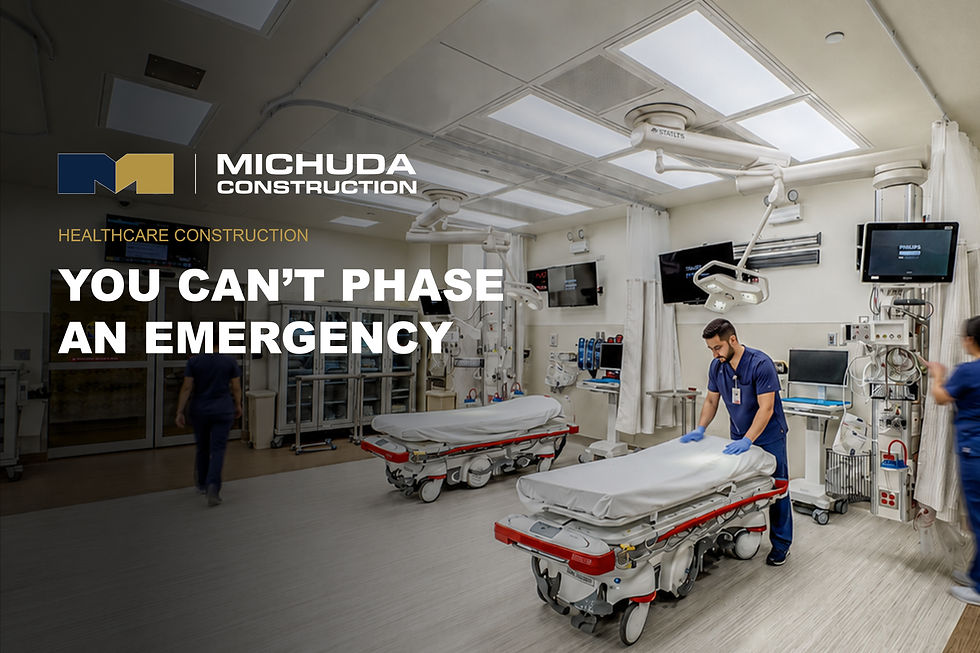
Leaders in Occupied Space: Where Healthcare Construction Is Truly Proven
A century-proven approach to building inside active healthcare environments—without disrupting care.
Occupied healthcare construction is not a subset of the industry. It is the industry at its most unforgiving.
It is where theory meets consequence. Where planning errors are not inconvenient but dangerous. Where schedule slippage does not merely impact budgets, but patient access. Where dust control, airflow, vibration, noise, and sequencing are not technical details—they are clinical imperatives.
In these environments, there is no such thing as “business as usual.” Care is being delivered in real time. Patients are vulnerable. Clinicians are focused on outcomes that matter far more than construction. And the building itself is an active, living system that cannot be interrupted, compromised, or placed at risk.
This is where Michuda works.
For generations, Michuda has built its reputation not on ideal conditions or greenfield sites, but inside active hospitals, surgical suites, imaging departments, procedural environments, and mission-critical care spaces—often operating within inches of live patient care. These are projects defined by constant coordination, zero tolerance for error, and an unrelenting demand for precision.
Occupied space is not a challenge to be overcome. It is a discipline to be mastered.
Precision Is Not a Buzzword—It Is a Requirement
In occupied healthcare environments, success is measured by what never happens.
No infections traced back to construction activity. No unplanned shutdowns. No disruptions to clinical workflows. No compromises to patient safety, staff operations, or regulatory compliance.
Achieving this level of performance requires far more than experience—it requires systems, discipline, and a deeply ingrained understanding of how healthcare buildings actually function while in use.
Michuda approaches occupied space construction with a mindset rooted in control. Every project begins with exhaustive planning: understanding adjacencies, identifying risk zones, coordinating shutdowns, sequencing work around care delivery, and aligning with infection prevention, facilities, and clinical leadership long before tools arrive on site.
Airflow is analyzed and protected. Barriers are designed, installed, and monitored. Noise, vibration, and access are managed with the same rigor as structural and MEP scopes. Every trade partner is aligned to the same expectations—not because they are written in a plan set, but because they are enforced through culture and execution.
This is not reactive construction. It is deliberate, disciplined, and exacting.
Experience That Cannot Be Simulated
Occupied healthcare expertise cannot be accelerated. It cannot be learned in isolation. And it cannot be improvised.
It is built project by project, shutdown by shutdown, over decades of working under real clinical pressure. It is reinforced by teams who understand that the environment they are working in is not theoretical—it is active, sensitive, and consequential.
Michuda’s teams operate with what can only be described as muscle memory. They know how to work within constraints without asking for exceptions. They know when to slow down, when to re-sequence, and when to stop work entirely because patient care comes first.
This experience extends beyond technical execution. It shows up in how Michuda communicates—with clarity, transparency, and respect for the realities healthcare operators face every day. Issues are raised early. Risks are surfaced honestly. Solutions are presented with full understanding of downstream impacts.
Healthcare leaders trust Michuda not because challenges don’t arise—but because when they do, they are handled with professionalism, accountability, and control.
Trust Is Earned Where the Stakes Are Highest
Healthcare organizations do not choose occupied-space partners lightly. The cost of failure is too high. The margin for error is too small. And the reputational risk—to patients, staff, and the institution itself—is too great.
Trust in this environment is not built through promises. It is built through performance.
Michuda has earned that trust by repeatedly delivering in environments where others hesitate. By taking responsibility, not deflecting it. By understanding that occupied healthcare construction is as much about judgment as it is about means and methods.
This is why Michuda is brought into projects early. Why teams are asked back. Why long-term relationships endure across campuses, systems, and generations of leadership.
Because when care cannot stop, and failure is not an option, certainty matters more than slogans or panache.
A Standard Defined by Accountability
There is a clear distinction between firms that can work in occupied healthcare spaces and firms that are defined by them.
Michuda belongs to the latter.
The company’s approach reflects a belief that leadership in healthcare construction is not about scale or visibility—it is about accountability. About understanding the weight of responsibility that comes with working inside spaces where outcomes matter deeply and immediately.
Occupied space construction is where Michuda’s values are most visible: discipline, preparation, respect for care delivery, and an unwavering commitment to doing the work the right way—every time.
This is not work for every contractor. And it is not work entrusted to many.
It is work reserved for those who have proven, over time, that they understand what is truly at stake.
The Only Measure That Matters
At the end of an occupied healthcare project, there is no grand reveal. Often no ribbon-cutting focused on construction. No tolerance for error explained away by complexity.
There is simply continued care—uninterrupted, uncompromised, and safe.
This is the measure Michuda holds itself to.
And that is why healthcare leaders who understand the realities of occupied space construction know exactly what this expertise is worth.
When the environment is critical. When patients are present. When operations cannot pause.
Michuda is quietly leading the charge.