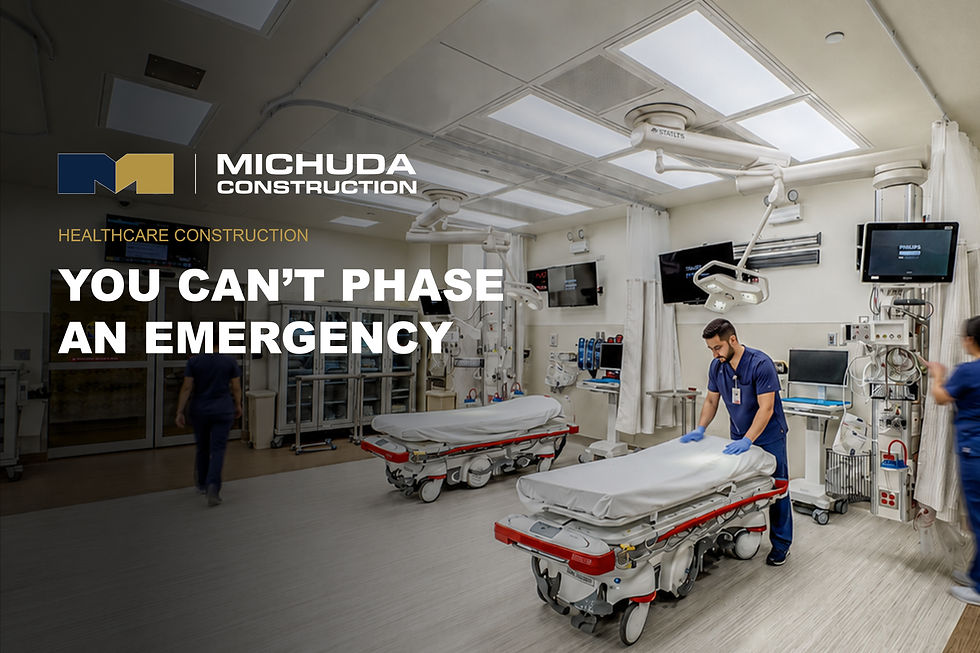
The Hidden Dangers of Healthcare Construction
Why dust, airflow, water, utilities, and temporary conditions deserve as much attention as the work itself
By Tony Michuda, Vice President of Development, Michuda Construction
A missing guardrail is easy to see. So is an open excavation, an improperly stored ladder, or a worker without the right personal protective equipment.
Healthcare construction has all of those conventional construction risks.
But some of the risks that matter most inside an operating hospital are nearly invisible.
Air moving in the wrong direction. Dust escaping through a ceiling cavity. A water line sitting stagnant after construction. A temporary penetration through a rated wall. A mislabeled electrical circuit. A shutdown affecting one more department than the drawings indicate.
None of these conditions necessarily looks dramatic.
That is exactly what makes them dangerous.
Inside an active healthcare facility, safety cannot stop at the edge of the construction site. The environment surrounding the work is part of the job too.
The Jobsite Is Bigger Than the Barrier
One of the easiest mistakes to make in hospital construction is assuming the construction boundary defines the area of risk.
It does not.
A project may occupy 5,000 square feet, while the systems affected by that work extend through several floors, departments, shafts, mechanical rooms, and occupied spaces.
Air, water, vibration, noise, utilities, and people all move beyond the construction boundary.
A wall may separate the contractor from a patient room, but the mechanical system above that wall may serve both spaces. A plumbing tie-in may affect departments nowhere near the project. A delivery route may cross patient circulation. Demolition debris may leave through elevators shared with hospital operations.
Healthcare construction requires teams to think beyond the physical limits of the project.
The barrier is important. The systems and operations that cross it are even more important.
Dust Is Not Just a Housekeeping Problem
On a conventional jobsite, dust is often treated primarily as a worker-safety, housekeeping, or nuisance issue.
Inside a hospital, it can be something very different.
Construction activity can disturb particles and contaminants that should never enter occupied clinical environments, particularly areas serving patients whose immune systems are compromised.

This is why infection-control planning has to begin before demolition and continue throughout the work.
Containment is more than erecting a temporary wall. The team may need to establish negative pressure, verify pressure relationships, filter exhaust air, control worker entry and exit, contain debris, seal penetrations, manage ceiling access, and continuously inspect the integrity of the work area.
And the system has to perform every day.
A barrier can look perfect from the hallway and still have an opening above the ceiling. A pressure monitor can be mounted on the wall and still be ignored when its reading changes. A worker can follow the correct debris route ten times and take a shortcut on the eleventh.
Healthcare infection prevention is not achieved by having the right equipment on site.
It is achieved by maintaining the right conditions consistently.
Airflow Has No Respect for a Construction Schedule
Hospitals depend on carefully controlled pressure relationships.
Certain rooms are intended to remain positive relative to surrounding areas. Others are negative. Air changes, filtration, temperature, humidity, and pressure all support the clinical function of the space.
Construction can interfere with those relationships surprisingly quickly.
Opening a ceiling, disconnecting ductwork, creating a temporary wall, blocking a return-air path, changing a door condition, or installing a temporary exhaust system can all alter how air moves through the building.
That does not mean the work cannot occur.
It means the effect has to be understood before it does.
Negative pressure should not simply be established at the beginning of a project and forgotten. Conditions change as construction progresses. Walls come down. New walls go up. Openings are created and closed. Equipment moves. Temporary ductwork changes. Adjacent spaces may change use.
The containment strategy has to evolve with the project.
Water Deserves the Same Attention as Air
Construction teams have become increasingly sophisticated about airborne infection risk.
Water can receive less attention.
That is a mistake.
Healthcare water systems are complex, and construction can alter the conditions within them. Portions of piping may sit unused. New branches may be installed before they are placed into service. Pressure can change. Temperatures can fluctuate. Existing systems can be disturbed during tie-ins.
The risk is not necessarily visible when a faucet is opened and clear water comes out.
That is why water management during construction has to be coordinated with the hospital’s facilities and infection-prevention teams.
The questions are practical: How long has this line been stagnant? Does it need to be flushed? What existing areas will be affected by the shutdown? What happens when service is restored? Has new piping been properly cleaned and prepared before use?
These are not simply plumbing questions.
They are healthcare operational questions.
Existing Conditions Are Sometimes the Biggest Unknown
Hospitals are rarely static buildings.
They grow. Departments move. Infrastructure gets extended. Systems are rerouted. Projects are completed above ceilings and behind walls over decades.
Record drawings can be extremely valuable, but no experienced renovation team should assume they tell the complete story.
That uncertainty matters most when construction touches critical systems.
A valve may not isolate exactly what everyone believes it isolates. A panel schedule may not reflect every downstream load. A medical gas line may have been extended during a previous project. An abandoned penetration may compromise an assembly nobody planned to disturb.
The correct response is not to distrust the drawings.
It is to verify the conditions that carry meaningful consequences.
System tracing, selective demolition, scanning, above-ceiling investigation, field verification, and conversations with facilities personnel can expose conditions while the team still has time to plan around them.
There is a major difference between finding something unexpected during preconstruction and finding it halfway through a critical shutdown.
Temporary Does Not Mean Less Important
Some of the most consequential elements of a healthcare project are eventually removed.
Temporary partitions, temporary egress routes, temporary utilities, temporary fire-protection measures, temporary wayfinding, temporary exhaust, and temporary access may never appear in the finished project.
Because they are temporary, they can sometimes receive less attention than permanent work.
They should receive more.
A temporary condition often exists precisely because a permanent protection has been interrupted.
If an exit route changes, occupants still need a safe route out. If a fire-rated assembly is penetrated, the facility still needs an appropriate interim strategy. If a utility must be taken offline, the clinical operation it supports may still need service.
Construction teams naturally focus on where the project is going.
Healthcare teams also have to manage what exists while getting there.
One Shutdown Can Reach Far Beyond the Project
Few activities illustrate invisible risk better than a hospital shutdown.
The physical work may appear simple: close a valve, de-energize a panel, interrupt a medical gas service, tie into an air handler, and then restore the system.
But the real question is not what the contractor intends to shut down.
It is what the system actually serves.
That is where disciplined planning becomes essential.
Affected departments need to be identified. Existing conditions need to be verified.
Contingencies need to be established. Communication has to reach the right people. The team needs clear criteria for proceeding, stopping, and restoring service.
The strongest shutdown plans also recognize that the unexpected can happen.
A valve does not hold. A breaker controls something that was never documented. A connection takes longer than expected. An emergency clinical need changes the approved window.
The objective is not to pretend those possibilities do not exist.
It is to have a response before they occur.
Patient Safety and Worker Safety Are Not Competing Priorities
Healthcare construction adds another layer to the traditional safety conversation, but it does not replace it.
Workers still face falls, electrical hazards, material handling, tools, equipment, silica, confined spaces, and the ordinary risks present on construction sites.
Patients and hospital staff face a different set of exposures.
A strong healthcare safety culture has to protect both.
That means the superintendent may be thinking about fall protection inside the project while simultaneously managing infection-control containment at the boundary. An electrician may need appropriate PPE while also understanding why a particular corridor cannot be obstructed. A laborer moving demolition debris has to protect himself while following a route designed to protect patients.
These responsibilities are interconnected.
The safest construction environment is one where workers understand not only how they are expected to work, but why the healthcare environment requires additional controls.
The Best Safety Systems Make Risk Boring
There is a tendency to associate safety expertise with dramatic intervention.
In reality, the best healthcare safety programs make potentially serious risks feel routine.
Pressure is checked. The barrier is inspected. The shutdown meeting happens. The route is confirmed. The penetration is sealed. The water-management protocol is followed. The temporary condition is documented.
Then everyone does it again tomorrow.
There is very little drama when the system works.
That is the point.
Healthcare construction depends on recognizing risks that may never be obvious to a patient walking past the project.
The absence of an incident does not mean the risks were insignificant.
Often, it means somebody identified them early enough that they never became incidents at all.
The visible construction is only part of the job.
The invisible conditions surrounding it are where experience matters most.
About the Author
Tony Michuda is Vice President of Development at Michuda Construction, a fifth-generation construction firm specializing in complex projects within occupied healthcare environments. Michuda has delivered more than 1,600 healthcare projects across over 70 hospital campuses.