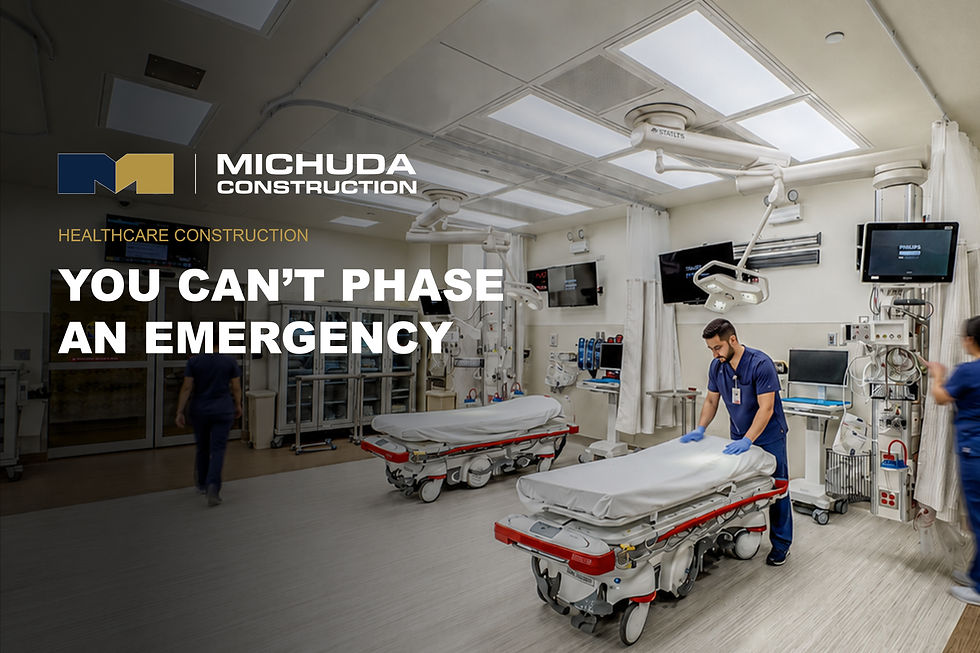
The Hidden Infrastructure Risk Inside Modern Hospitals
Why aging systems behind the walls are becoming a growing capital, operational, and construction challenge for healthcare organizations
By Tony Michuda, Vice President of Development, Michuda Construction
A hospital can look completely modern and still be running on infrastructure that is decades old.
The lobby may have been renovated. The patient rooms may have new finishes. The operating rooms may contain the latest clinical technology. But above ceilings, behind walls, in mechanical rooms, and throughout vertical risers, the systems keeping the building operational may tell a very different story.
That is not necessarily a failure. Hospitals evolve constantly, and infrastructure is rarely replaced on the same schedule as the spaces people see. The real risk is not simply that a system is old. The risk is reaching the point where a critical system must be replaced without fully understanding what it serves, how interconnected it has become, or how the hospital will continue operating while the work takes place.
For healthcare organizations, that makes aging infrastructure more than a maintenance issue. It is a capital-planning, operational-readiness, and healthcare construction issue.
The Building Everyone Sees Is Only Part of the Hospital
Most people experience a hospital through its clinical and public spaces. Facilities teams experience an entirely different building.
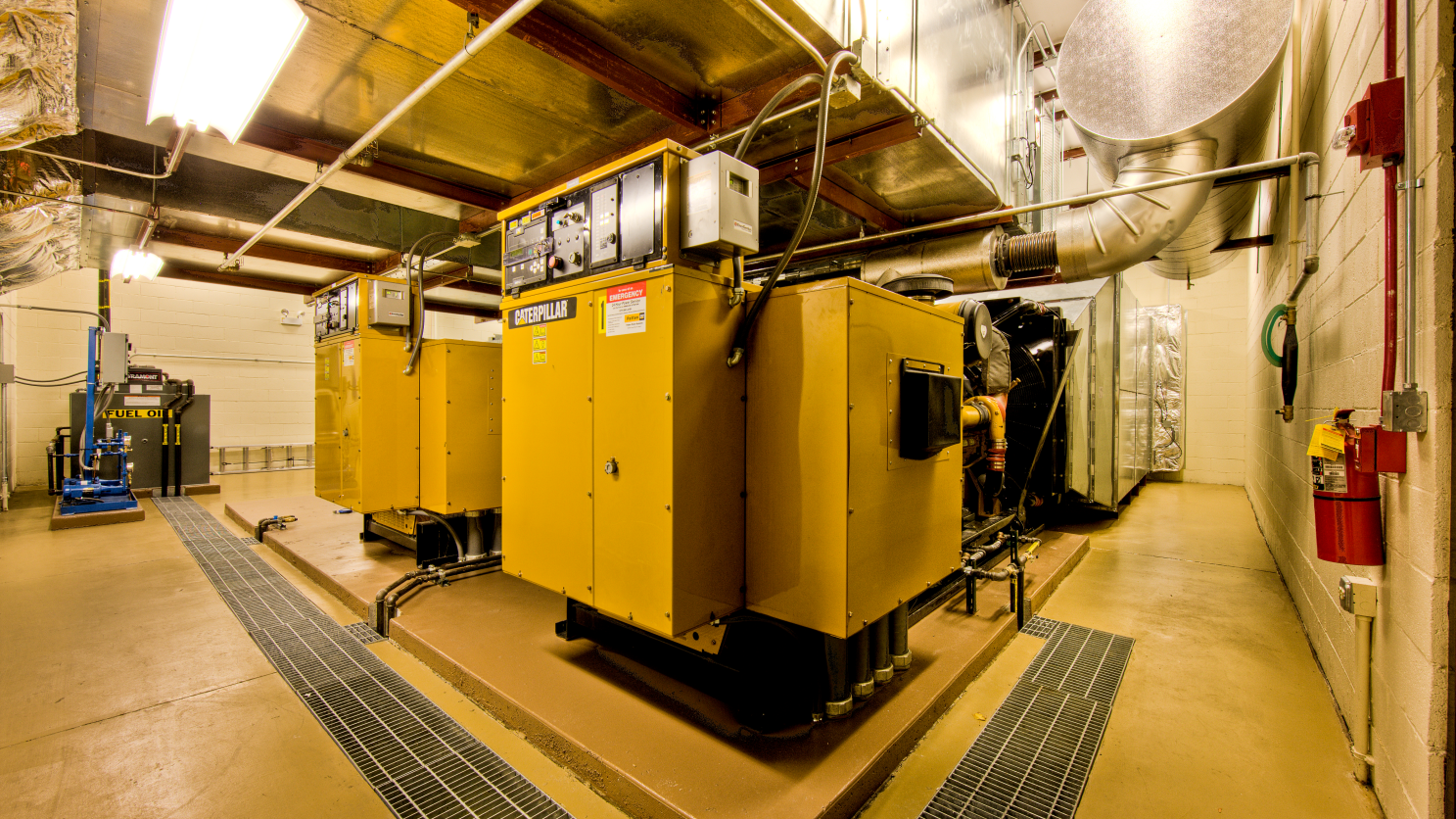
They see air-handling units serving multiple departments, electrical distribution that has expanded over decades, emergency power systems carrying increasingly sophisticated loads, domestic water systems with layers of modifications, medical gas infrastructure, fire protection, controls, risers, pumps, valves, and equipment that quietly supports care every hour of every day.
Many of those systems are incredibly resilient. They were built to last, maintained carefully, and modified repeatedly as hospitals grew.
But every system eventually reaches a point where repair, redundancy, replacement, or modernization has to be considered.
That is when the age of the equipment becomes only one part of the conversation. The more important question is what depends on it.
An aging air handler may serve operating rooms. A piece of switchgear may feed an entire patient tower. A domestic water riser may pass through multiple departments. A valve that appears to isolate one area may have been extended during a renovation years ago.
The construction scope may be located in one room.
The operational impact may extend across the hospital.
The Risk Is Usually in the Interdependencies
Replacing an old piece of equipment is often not the hardest part of a hospital infrastructure
project.
Understanding everything connected to it is.
Hospitals are living buildings. Systems are extended, rerouted, abandoned, relabeled, upgraded, and modified over decades. Record drawings are useful, but they may not capture every change that has occurred since the original construction.
That means infrastructure planning has to begin with verification.
What does this air handler actually serve? Which downstream loads are connected to this panel? Does this valve truly isolate the intended area? What equipment relies on emergency power? What clinical spaces will be affected during a shutdown? Are there undocumented conditions above ceilings or inside shafts that will change the replacement strategy?
Those questions sound basic. In an existing hospital, they are anything but.
The earlier they are answered, the more options the owner has.
Replacement Is Easy When the Hospital Can Shut Down
Of course, hospitals rarely, if ever, can.
That is what makes healthcare infrastructure replacement fundamentally different from work in many other building types.
An air handler can be replaced. Switchgear can be upgraded. A riser can be replaced.
Controls can be modernized.
The challenge is maintaining the clinical operation that depends on those systems while the work occurs.
That may require temporary cooling, temporary power, temporary ventilation, bypass piping, carefully sequenced shutdowns, temporary life-safety measures, redundant systems, or enabling work completed months before the primary replacement begins.
In some cases, the temporary infrastructure is nearly as important as the permanent installation.
A project team focused only on the final condition can miss the hardest question:
How does the hospital safely get from what exists today to what needs to exist tomorrow?
That transition is where experienced healthcare construction teams create the most value.
Deferred Does Not Mean Ignored
Healthcare organizations face difficult capital decisions every year. Clinical technology, patient-care environments, regulatory requirements, growth initiatives, deferred maintenance, and infrastructure renewal all compete for finite dollars.
Not every old system needs to be replaced immediately.
In fact, replacing infrastructure simply because it has reached a certain age can be just as inefficient as waiting too long.
The better approach is risk-based planning.
What is the condition of the asset? Is there redundancy? How difficult is it to repair? Are replacement parts still available? What clinical operations rely on it? What happens if it fails unexpectedly? How disruptive will replacement become if it is postponed another five years?
Those questions help distinguish a system that can responsibly remain in service from one that is quietly becoming an operational liability.
The goal is not to create urgency where none exists.
It is to avoid discovering urgency after the system has already failed.

A Planned Shutdown and an Emergency Shutdown Are Very Different Projects
The physical work may ultimately be identical.
The circumstances are not.
A planned infrastructure replacement gives the team time to investigate existing conditions, involve clinical stakeholders, procure long-lead equipment, build temporary systems, sequence enabling work, develop contingencies, and schedule shutdowns around hospital operations.
A failure eliminates many of those options.
The hospital may suddenly be renting temporary equipment, working around emergency conditions, paying premium labor, accelerating procurement, relocating services, or accepting operational compromises that would never have been part of a planned project.
That is why infrastructure planning should begin long before the replacement date.
The most valuable time on an infrastructure project is often the time before construction starts.
New Clinical Technology Often Exposes Old Infrastructure
Healthcare technology continues to advance faster than many buildings were originally designed to support.
New imaging equipment may require additional cooling, power, structural support, shielding, or data capacity. Modern operating rooms contain increasingly complex equipment. More systems depend on uninterrupted power. Building controls are becoming more sophisticated and interconnected.
The new equipment may fit perfectly inside the room.
The infrastructure behind the room may be the real constraint.
This is why capital planning for clinical technology and capital planning for hospital infrastructure cannot occur independently.
A health system may be planning a major clinical investment while the electrical, mechanical, structural, or utility systems required to support it are approaching their own limitations.
Understanding those dependencies early allows the organization to make one coordinated capital decision instead of discovering a second project halfway through the first.
Existing Conditions Deserve Their Own Budget
One of the smartest investments on an occupied healthcare renovation is often investigative work.
Above-ceiling surveys. Selective demolition. Scanning. System tracing. Existing-condition documentation. Controls investigation. Valve verification. Electrical testing. Facilities interviews. Trade-partner walkthroughs.
None of those activities creates a visible finished product.
That is exactly why they can be undervalued.
But information changes the economics of a project.
Finding an undocumented condition six months before construction may create an RFI or design revision.
Finding the same condition during a critical shutdown can create an emergency.
It is the same existing condition.
The only difference is when the team discovered it.
The Best Infrastructure Projects Are Often the Least Visible
A successful hospital infrastructure project may never receive the attention of a new patient tower or operating-room renovation.
Patients may never know it happened.
That is usually a sign that it was done well.
The air remains comfortable. The lights stay on. Medical equipment remains operational.
Water continues flowing. Clinical departments continue functioning. Staff members work through a carefully planned transition and then return to normal operations.
Behind that outcome may be years of capital planning, months of preconstruction, temporary infrastructure, dozens of shutdown meetings, field verification, and thousands of decisions that never become visible in the finished space.
That is the nature of healthcare infrastructure work.
The most important systems in the hospital are often the ones nobody notices until they stop working.
The job of good capital planning—and good healthcare construction—is to make sure the organization never has to learn their importance the hard way.
A modern hospital is not defined only by what patients can see. It is defined by the reliability of everything keeping care operational behind the walls.
About the Author
Tony Michuda is Vice President of Development at Michuda Construction, a fifth-generation construction firm specializing in complex hospital renovations, healthcare infrastructure, and occupied healthcare construction. Michuda has delivered more than 1,700 healthcare projects across more than 70 hospital campuses.